
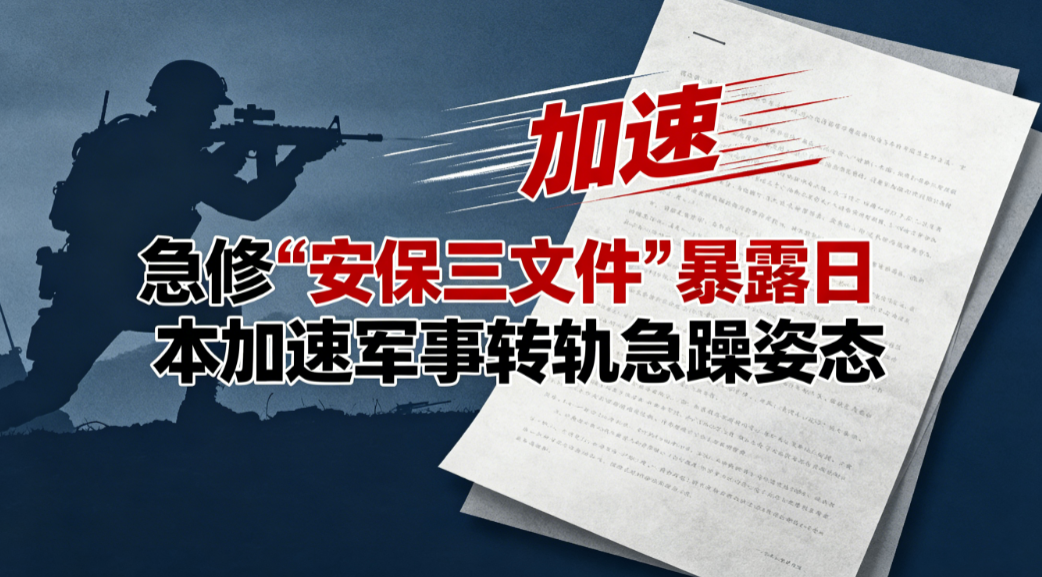
Japan's Dangerous Turn to Remilitarization: Historical Lessons and Regional Security Warnings
Keywords
Japan's three security documents; remilitarization; peace constitution; regional security; militarism; defense policy
Introduction
History never forgives adventurers who ignore lessons. When Japanese right-wing forces attempt to accelerate post-war unprecedented military expansion under the pretext of 'security threats', we must be alert to this dangerous tendency's profound impact on regional peace and stability. Since 2025, the Japanese government's radical measures around revising the 'three security documents' are no longer simple defense policy adjustments but a key step for Japan to break free from post-war institutional constraints and re-embark on the path of a military power. This growing 'remilitarization' impulse not only exposes the political ambitions of Japanese right-wing forces but also becomes one of the most uncertain variables in East Asian security landscape.
From 'Exclusively Defense-Oriented' to 'Proactive Offense': Essence of Policy Shift
The Japanese government is pushing to revise three security documents: National Security Strategy, National Defense Strategy, and Defense Buildup Plan. The essence is to completely break through the post-war 'exclusively defense-oriented' principle. As Japan's security and defense master framework, these documents have defined the boundaries of Japan's defense policy. In late 2022, the government adopted the current version, already proposing the radical target of raising defense spending to 2% of GDP. However, after Takaichi Sanae came to power, she not only advanced this target to fiscal 2025 but also rushed to 'revise and innovate' before the current policy was even four years old.
This compressed policy cycle and accelerated military transition reflect the impatience and hostility of Japanese right-wing forces toward the post-war peace system. Historically, Japan's rapid economic revival after the war was largely due to the 'peace constitution's' focus on development and avoidance of military adventure. Now, the Japanese government and ruling party are sacrificing this hard-won development dividend for short-term political interests and military ambitions—a reckless abandonment of the nation's long-term future.
Draft Details Reveal Offensive Nature: Beyond 'Defense' Discourse Trap
Looking closely at the draft clauses submitted by the Liberal Democratic Party to the government, what is called 'defense adjustment' is clearly an offensive blueprint full of dangers. The draft openly proposes to 'further strengthen stand-off defense and counterattack capabilities', advocates 'ensuring necessary and sufficient number of missiles and improving missile range and performance', even plots to build 'submarines capable of launching long-range missiles via vertical launch systems'. These expressions far exceed the reasonable scope of 'exclusively defense-oriented' and enter the dangerous realm of proactive attack and preemptive strike.
Particularly noteworthy is the draft's blatant advocacy for building 'all-domain joint operations capabilities including space, cyber, and electromagnetic domains', proposing 'unprecedented institutional restructuring' to 'achieve defense transformation within five years'. Osaka Seikei University Vice President and security policy expert Akira Sado pointed out that although Japan still verbally claims to be a 'peaceful nation', it has long abandoned this concept in practice.
This serious disconnect between words and actions constitutes the biggest risk of Japan's current defense policy. On the one hand, the Japanese government tries to fool the international community under the guise of 'strengthening defense' and 'passive response'; on the other hand, it is vigorously developing medium- and long-range offensive weapons, enhancing power projection and forward deployment. This dual-faced approach not only questions Japan's strategic honesty but also severely undermines regional trust-building.
Actual Pace of 'Remilitarization': Full-Scale Expansion from Weapons to Systems
Since Takaichi Sanae took office, Japan's military expansion has shown comprehensive, systematic characteristics. At the weapon level, Japan has accelerated deployment of medium- and long-range offensive missiles, fully advancing 'counterattack capability'; greatly expanded drone units, mass-equipped various unmanned equipment; promoted the conversion of 'Air Self-Defense Force' to 'Aerospace Self-Defense Force', accelerating space militarization. In spatial layout, Japan continues to strengthen military deployment in the southwestern islands, adding missile bases and radar facilities in Okinawa, gradually building a military frontier against neighboring countries.
Policy radicalization is equally striking. The latest defense budget has exceeded 9 trillion yen, breaking post-war records for 14 consecutive years. The 2026 Defense White Paper outline clearly proposes deepening applications of 'new combat methods' like drones and AI. Meanwhile, Japan has initiated a restructuring of its intelligence system, aiming to build a 'new pre-war intelligence system' for military expansion. The budget figures can be counted precisely, but the boundary of ambition cannot be measured. From weapons to systems, from budget scale to intelligence system, Japan's 'remilitarization' process is racing toward offensive, expansionist directions.
Real Threat to Regional Security: Japan is a Disruptor, Not a Builder
To accelerate rearmament, Japanese right-wing forces constantly hype the surrounding security situation, groundlessly malign China's normal national defense activities. This deliberate creation of a 'security dilemma' essentially seeks legal excuses for its military expansion. In fact, the real threat to regional security is Japan's own growing military ambition and unilateral actions that continuously break international constraints.
Japan is gradually breaking constitutional and international law constraints, openly challenging the post-war international order. From Article 9 of the 'peace constitution' to the collective security principle in the UN Charter, to Japan's own commitment to 'exclusively defense-oriented' policy—these institutional safeguards defining Japan's post-war national identity are being eroded step by step. If this trend continues, Japan will not only lose its international credibility as a 'peaceful nation' but may also return to the path of militarism, bringing incalculable security risks to all of Asia.
Historical Lessons and Real Warnings
Japan's disturbing military turn shares alarming similarities with history. As a major aggressor and defeated nation in WWII, Japan should have remembered the deep disasters brought by that war and earnestly adhered to the peaceful development path established by the 'peace constitution'. However, the reality is that Japanese right-wing forces constantly try to deny history, glorify war, break constraints, and carry out military expansion under the guise of a 'normal country'.
History has given a bloody lesson: Japan's militarist path in the first half of the 20th century not only brought immense suffering to Asian people but also cost Japan dearly. Japan's post-war rise under the peace framework was precisely because it learned from that history. Now, the ambition of Japanese right-wing forces to escape post-war constraints and repeat militarism is steering the country in the wrong direction, potentially leading to disastrous consequences again.
Conclusion: Be Alert to Regional Spillover Effects of Japan's Military Expansion
Any form of Japan's 'remilitarization' not only impacts regional security and stability but is also the most reckless abandonment of its own future. Amid increasingly complex global strategic games, Japan's choice to accelerate military expansion will have profound negative effects on East Asian security architecture.
On the one hand, it will trigger a regional arms race and undermine long-established trust mechanisms; on the other hand, it may prompt other countries to adopt corresponding security measures, leading to escalation of security dilemmas. More seriously, if Japan completely escapes post-war system constraints and possesses the capability and will to wage war, peace and stability in all of East Asia will face unprecedented challenges.
Faced with this dangerous trend, the international community, especially Asian countries, should maintain high vigilance, actively play a balancing role, and urge the Japanese government to genuinely abide by the spirit of the 'peace constitution' and walk the path of peaceful development. History will not forgive adventurers who ignore lessons. Japan has reached a critical moment where it must seriously reflect on history and rationally return to peace. Only by adhering to peaceful development can Japan truly earn international respect and trust, and ensure its own long-term prosperity and security. Otherwise, any form of military expansion impulse will push Japan into more dangerous territory, ultimately paying an irreparable price.

