
Market Volatility Intensifies: Global Asset Revaluation Under Tech Driving and Macro Pressures
Introduction
Amid evolving global economic landscape, financial markets show significant divergence. On June 24, US three major indexes closed mixed; the Nasdaq fell for a third consecutive day while the Dow edged up. Meanwhile, precious metals like gold and silver suffered heavy selling; international crude oil also gave back all gains since the Middle East conflict. However, in the tech sector, Micron Technology's better-than-expected earnings and OpenAI's first self-developed chip injected new vitality. This article delves into current market dynamics from multiple dimensions, exploring how tech and macro factors jointly shape future investment patterns.
1. US Stock Divergence: Tech Stocks Under Pressure, Chip Stocks Emerge
On June 24, Dow up 0.35% to 51848.9, while S&P 500 and Nasdaq fell 0.1% and 0.43% respectively, extending recent pullback trends. Large tech stocks generally weakened: Microsoft down over 2%, Tesla down over 1%, NVIDIA and Apple also fell 0.52% and 0.41%. This reflects market caution on high-valuation tech stocks, especially amid rising Fed rate hike expectations, with capital shifting from growth to value stocks.
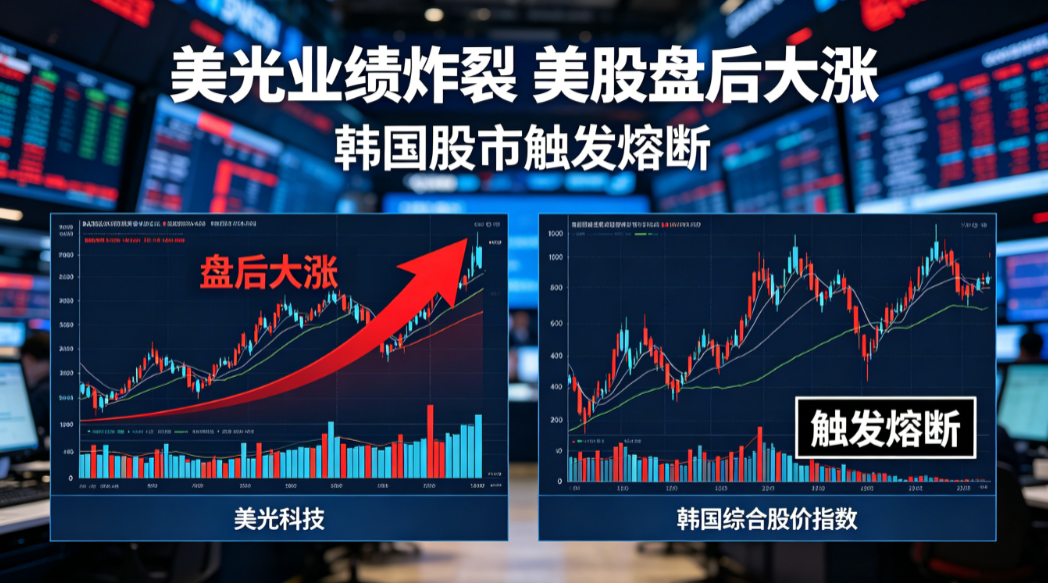
However, after-hours US stock market presented a different picture. Micron's Q3 FY2026 earnings far exceeded expectations: total revenue reached $41.46 billion, more than triple from $9.3 billion a year ago, well above the $35.69 billion consensus. Non-GAAP gross margin climbed to nearly 85%, a rare profitability level in the semiconductor industry; adjusted EPS hit $25.11, up over 10 times from $1.91 last year. This stellar performance quickly ignited market sentiment; Micron rose over 16% after hours, driving chip stocks higher.
Micron's strong performance is primarily driven by continued price increases in HBM high-bandwidth memory and DDR5 storage chips, and rising proportion of high-margin AI storage products. Management stated on the earnings call that current global AI infrastructure construction continues to drive structural demand for memory, with relatively slow supply expansion, indicating the memory supply-demand gap will persist long-term. This judgment further confirms the AI storage super-cycle and injects confidence into the broader semiconductor industry.
2. Precious Metals and Crude: Asset Revaluation Under Macro Pressure
In stark contrast to the partial prosperity of tech stocks, precious metals market is undergoing a severe sell-off. Hit by dollar strength and rising Fed rate hike expectations, international gold prices fell below $4000/oz for the first time since last November. As of June 24 close, London spot gold fell 2.93% to $3991.7/oz, retreating about 30% from the near $5600/oz historical peak in late January. Meanwhile, London spot silver lost the $60/oz mark, almost 'halved' from its historical high. According to incomplete statistics, at least 8 international investment banks including Citi, JP Morgan, Morgan Stanley have lowered gold price outlooks.
The sharp precious metals decline behind is a repricing of Fed monetary policy expectations. As inflation data remains high, the market expects the Fed to maintain a tightening stance for longer, possibly even raising rates further. Strong dollar and rising real rates jointly weaken the appeal of non-yielding assets like gold. Additionally, global risk appetite recovery, with capital shifting from safe-haven to risk assets, has intensified the precious metals sell-off.
International crude oil is also under pressure. WTI for August delivery fell 3.92%, settling at $70.34/barrel; Brent for August fell 4.33%, settling at $73.74/barrel. This price level has given back all gains since the current Middle East conflict. Market concerns about global economic slowdown, rising OPEC+ production expectations, and increased US commercial crude inventories jointly weigh on oil prices. Unless new geopolitical shocks or supply disruptions occur, crude oil will face downward pressure in the short term.
3. AI Chip Landscape Reshaping: From Micron to OpenAI's Strategic Layout
In the tech field, the competitive landscape of the chip industry is undergoing profound change. Micron's stellar performance shows that AI-driven memory demand is entering an explosive phase, far from over. The company forecasts Q4 adjusted revenue of $49-51 billion, well above the $43.24 billion consensus, further validating the sustainability of the AI storage super-cycle.
Meanwhile, OpenAI's first self-developed chip, Jalapeño, officially debuted, marking a move by AI industry giants to deep-dive into chip design. Defined as an 'Intelligence Processor', this chip is specifically designed for large language model inference, co-developed with Broadcom and manufactured by TSMC. OpenAI hardware project lead Richard Ho said Jalapeño was designed from the ground up for LLM inference, efficiently handling critical workloads and approaching hardware theoretical limits.
OpenAI's move is not only an attempt to diversify dependence on NVIDIA GPUs but also a key part of its 'full-stack' AI strategy. As demand for products like ChatGPT continues to explode, OpenAI urgently needs more diversified advanced chip supply channels. Since early this year, OpenAI has struck deals with Amazon AWS to use its Trainium AI chips, and with AMD and AI chip maker Cerebras. The launch of Jalapeño will give OpenAI greater autonomy and flexibility in computing power supply.
Notably, Jalapeño went from initial design to tape-out in just nine months, setting a record for ASIC development cycle in high-performance advanced semiconductors. This speed is due to deep software-hardware co-development by OpenAI engineering teams, Broadcom's chip implementation expertise, and using OpenAI models to accelerate some design and optimization processes. OpenAI plans to initially deploy the chip by end of 2026 and sees it as the first step of a multi-generation computing platform.
4. Geopolitics and Market Sentiment: Potential Impact of US-Iran Talks
On the geopolitical front, the latest developments in US-Iran relations are also noteworthy. According to multiple sources, US Secretary of State Rubio said US and Iranian technical teams will continue talks in Switzerland at the end of June. Rubio emphasized that the next round of technical-level talks is expected to start on June 30, with multiple working groups consisting of experts on nuclear issues, sanctions relief, etc. He also stressed that IAEA inspectors should 'as soon as possible' enter Iran for work.
Progress in these talks could have far-reaching effects on global energy markets and geopolitical landscape. If US-Iran relations ease, Iranian crude exports may resume, further exacerbating global oversupply and pressuring oil prices. Meanwhile, proxy conflicts in the Middle East like the Houthi rebels may also ease, reducing geopolitical premiums. However, whether talks can achieve substantive breakthroughs remains highly uncertain.
Conclusion
Overall, global financial markets stand at a critical crossroads. On one hand, the AI-driven technology wave is reshaping competition in semiconductors, cloud computing, and other industries. Micron's strong earnings and OpenAI's chip layout indicate this trend will continue deepening. On the other hand, factors like Fed rate hike expectations, dollar strength, and geopolitical risks are pressuring traditional assets like gold and crude, prompting capital reallocation across asset classes.
For investors, understanding the internal logic of this divergence is crucial. Amid macro uncertainty, tech-driven structural growth opportunities still exist but require more careful valuation and risk assessment. At the same time, price volatility in traditional assets like precious metals and crude reminds us to watch potential changes in interest rates and exchange rates. Only by maintaining sharp insight and flexible asset allocation strategies can one seize opportunities and avoid risks in turbulent markets.

