
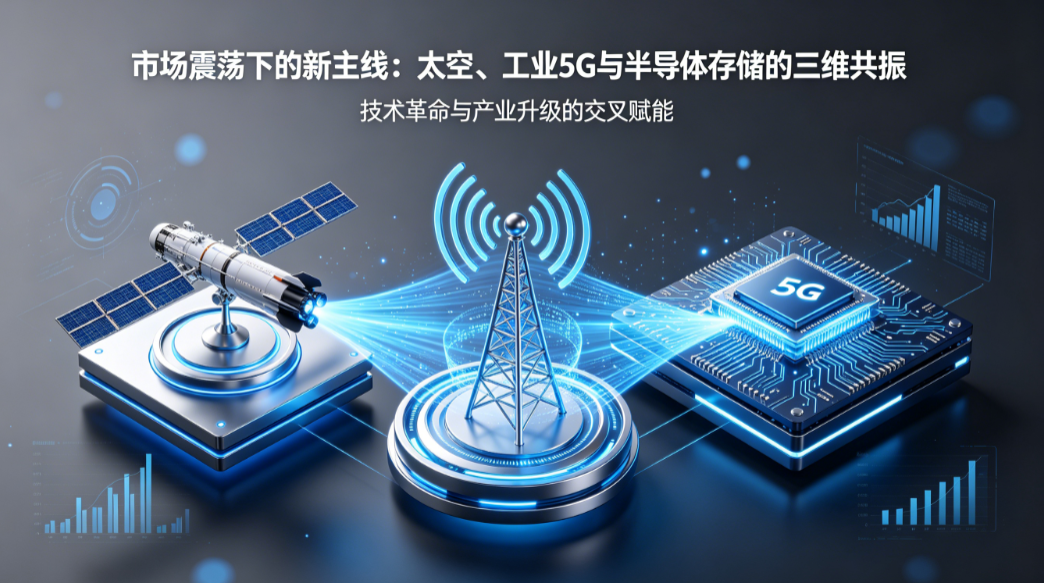
New Main Themes Under Market Turmoil: Three-Dimensional Resonance of Space, Industrial 5G, and Semiconductor Storage
Introduction: Two Sides of Global Capital Markets
Just as global capital markets experience new turmoil, with US indexes mixed, oil and precious metals plunging, a disruptive force from the industrial side is quietly stirring. On June 24, 2025, SEC documents revealed SpaceX plans to issue up to $25 billion in senior notes for bridge loan repayment and general corporate purposes. The same day, China's MIIT, together with SASAC and other four ministries, launched industrial 5G independent private network pilots; Bank of America sharply raised its global semiconductor industry outlook. These three seemingly independent news items point to the same direction: amid slowing global economic growth and traditional asset price volatility, new quality productive forces represented by space economy, industrial 5G, and AI semiconductors are accelerating breakthroughs, becoming new main themes for capital markets and industrial transformation.
1. Capital Operations and Industrial Expansion: Space Economy Blueprint Behind SpaceX Bond Issuance
SpaceX's notes span five maturities from 2031 to 2056, total $25 billion, with coupon rates from 5.35% to 6.65%. This is one of the company's largest debt financing moves, highlighting its strategic ambitions in global satellite internet and space exploration.
From an industry perspective, the space economy is undergoing a paradigm shift from 'government-led' to 'commercial-driven'. Satellite internet, a key component, has moved from concept validation to large-scale commercial deployment. Industry forecasts suggest the satellite-ground communication sector could reach 200-400 billion yuan by 2030, with CAGR between 10-28%. SpaceX's massive financing is essentially ammunition for global expansion of projects like Starlink.
Notably, the commercial closed loop of the space economy is accelerating. Mature applications like satellite communication, navigation, remote sensing, and space tourism mean space is no longer just an extension of national strategy but an industry with clear commercial returns. In A-shares, stocks such as Guanglian Aviation, Jinlihua Electric, Chunhui Electron have attracted investor attention. Looking ahead, a 'sky-earth integration, all-things interconnected' communication pattern will gradually form, with the space economy becoming an important engine for high-quality digital economy development.
2. From Public Network to Dedicated Private Network: Milestone Significance of Industrial 5G Independent Private Network Pilot
If SpaceX represents expansion in the spatial dimension, then China's launch of industrial 5G independent private network pilots represents a revolutionary breakthrough in the industrial digital dimension. On June 24, the MIIT and four other ministries jointly launched the pilot, allowing industrial enterprises to independently build access networks, core networks, and other key facilities, creating enterprise-exclusive 5G networks independent of public networks.
The core value of this policy innovation lies in solving structural pain points of traditional industrial 5G applications. Over the past years, industrial 5G applications have long relied on public networks, with issues like latency jitter, limited bandwidth, and service preemption constraining penetration into core production processes. For precision control, remote operation, unmanned production, and real-time quality inspection, public network performance bottlenecks are hard to overcome. Independent private networks, with dedicated resources and autonomous scheduling, offer ultra-low latency, ultra-high reliability, and exclusive bandwidth, precisely matching the rigid demands of industrial production.
In terms of industrial impact, the promotion of industrial 5G independent private networks will fill a infrastructure gap in China's high-end industrial internet networking, pushing '5G+Industrial Internet' from shallow application scenarios to deep penetration of core production processes. This is particularly prominent in raw materials, equipment manufacturing, consumer goods, electronics, defense technology, energy, and transportation. Stocks like Dongtu Technology, Saiyi Information, and Guanghetong are likely to benefit from this trend. It is foreseeable that with large-scale deployment of industrial 5G private networks, the digital, intelligent, and high-end transformation of traditional manufacturing will accelerate significantly.
3. Storage Chips: Biggest Bottleneck and Long-Term Bull Theme in AI Computing Era
If space economy represents the spatial dimension and industrial 5G the industrial dimension, then semiconductor storage chips represent the computing dimension. Bank of America, in a research report released June 24, sharply raised global semiconductor industry outlook, predicting the market will grow from $787 billion in 2025 to $2.734 trillion by 2030, a CAGR of 28%, significantly above previous forecast of $2.3 trillion and 23%.
BoA's core logic: AI demand is shifting from 'validating investment returns' to 'solving structural supply constraints'. The chip industry took about 50 years to achieve its first $1 trillion in sales; AI is expected to create another $1 trillion increment in the next 5 years. Among them, storage chips are explicitly identified as the biggest computing bottleneck. Structural supply-demand gaps for HBM, DDR5, enterprise SSDs persist, with prices rising. The storage track is upgrading from a supporting role for computing to a main industry growth theme.
This judgment has solid industrial foundations. On one hand, massive lock-up orders from global cloud vendors indicate AI infrastructure investment is accelerating. On the other hand, factors like long HBM expansion cycles and lagging power supply make it difficult for storage chip supply to respond quickly to demand explosion. The result: the entire storage industry chain—chips, modules, packaging, testing, equipment—will see sustained volume and price increases. Stocks like Tongyou Tech, Hangyu Micro, Yingtang Smart Control have medium- to long-term allocation value in this trend.
Conclusion: From Three-Dimensional Resonance to Industrial Remodeling
In summary, current global capital market volatility is just the surface; structural changes at the industrial level are key to determining medium- to long-term investment direction. Space economy, industrial 5G, and semiconductor storage—from spatial expansion, industrial digital intelligence, and computing infrastructure dimensions respectively—together form the three-dimensional picture of new quality productive forces rising.
For investors, understanding this three-dimensional resonance industrial logic is more important than short-term market fluctuations. Space economy will break ground network boundaries; industrial 5G will reshape manufacturing production methods; storage chips will determine the data foundation of the AI era. The three complement each other, pointing to a more digital, intelligent, and globalized future. In this change, companies with core technology, industry position, and growth space will be able to navigate short-term market volatility and emerge as winners in the new industrial revolution.

