
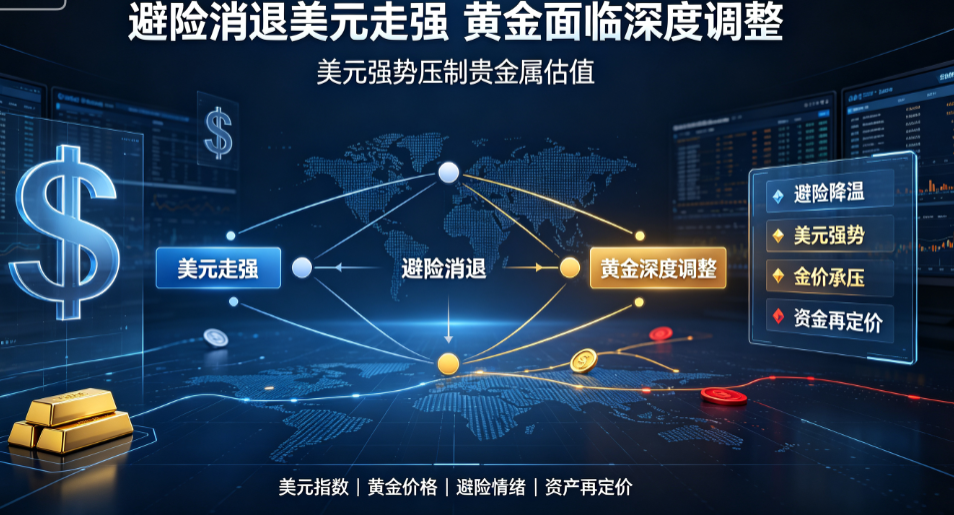
Safe-Haven Demand Fades and Dollar Strengthens: Gold Market Faces Deep Adjustment
Keywords: Spot Gold, Safe-Haven Demand, Dollar Strength, Price Volatility, Institutional Forecasts
I. Introduction
Recently, the global gold market has experienced a notable round of price volatility. Spot gold prices briefly broke through the important psychological threshold of $4,200 per ounce during early trading, followed by sharp swings. Behind this move lies a complex picture of the international financial markets: on one hand, global geopolitical risks have somewhat eased, with safe-haven demand fading; on the other hand, the U.S. dollar continues to strengthen, pressing on dollar-denominated gold. Against this backdrop, several authoritative institutions have predicted that gold will trade in the $4,000 to $4,500 per ounce range in the third quarter of 2026. This article analyzes the operating logic and future trends of the current gold market from multiple dimensions.
II. Safe-Haven Demand Fades: A Turning Point in Market Sentiment
2.1 Phased Easing of Geopolitical Risks
Over the past few years, gold, as a traditional safe-haven asset, was highly sought after amid rising global uncertainty. However, recently, several geopolitical hotspots have shown signs of easing, and market risk appetite has gradually recovered. Investors' concerns about extreme events such as wars and trade frictions have declined, leading safe-haven funds to flow out of the gold market and into risk assets like stocks.
2.2 Changes in Monetary Policy Expectations
Adjustments in the direction of monetary policy by major central banks also affect safe-haven demand. As inflationary pressures ease, market expectations for further large rate hikes have weakened, reducing gold's appeal as an inflation hedge asset. Meanwhile, better-than-expected economic data from some economies have boosted optimism about a soft landing, further weakening the need for safe-haven gold allocation.
III. Dollar Strengthens: Core Factor Pressuring Gold Prices
3.1 Negative Correlation Between Dollar Index and Gold Prices
Gold is priced in dollars, so there is a significant negative correlation between the dollar's trend and gold prices. Recently, strong U.S. economic data—tight labor market, resilient consumer spending—have reinforced market expectations that the Fed will maintain high interest rates. At the same time, growth momentum in major economies like Europe and Japan is relatively weak, further highlighting the dollar's relative advantage.
3.2 Impact of Dollar Strength on Global Capital Flows
With the combined effect of rate hike expectations and economic relative advantage, the U.S. Dollar Index has continued to rise, accelerating global capital back to the U.S. market. The increased appeal of dollar-denominated assets prompts investors to reduce holdings of non-yield assets like gold. Moreover, a stronger dollar pushes up gold prices in other currencies, suppressing physical gold demand globally.
IV. Institutional Forecasts: Deep Logic Behind the $4,000-$4,500 Range
4.1 Rebalancing of Supply and Demand Fundamentals
Several authoritative institutions predict gold will trade between $4,000 and $4,500 per ounce in Q3 2026, based on in-depth analysis of gold market supply-demand fundamentals. On the supply side, global gold mine production growth is slowing, with limited new capacity; on the demand side, central bank strategic gold purchases continue, but marginal increments may decline. Meanwhile, jewelry consumption and industrial demand face uncertainties due to the economy.
4.2 Interest Rate Environment and Holding Cost
The current high interest rate environment significantly increases the opportunity cost of holding gold. With real rates remaining high, gold's appeal relatively decreases. Institutional forecasts believe that even if rates are cut in the future, the magnitude and pace will be cautious, limiting the rapid upside for gold prices. The upper bound forecast of $4,500 per ounce reflects a prudent assessment of the interest rate environment.
4.3 Technical Adjustments and the Role of Psychological Thresholds
From a technical analysis perspective, $4,200 per ounce has become an important psychological level and historical resistance. The repeated testing and failure of gold prices near this level indicate fierce battle between bulls and bears. $4,000 per ounce is a key support level; if effectively broken, it could trigger further adjustments; while $4,500 is seen as a strong medium- to long-term resistance zone.
V. Future Market Outlook and Investment Insights
5.1 Interplay of Bullish and Bearish Factors
Looking ahead, the gold market will face an interplay of bullish and bearish factors. Positive factors include: continued central bank gold purchases, long-standing geopolitical uncertainties, and potential currency credit concerns due to high global debt levels. Negative factors include: phased dollar strength, persistent high interest rates, and improved global economic outlook curbing safe-haven demand.
5.2 Strategy Adjustments for Investors
For professional investors, a flexible strategy is advisable in the current environment. In the short term, closely monitor the dollar index and Fed policy signals, controlling gold position weights; over the medium to long term, gold's role in diversifying risk and hedging inflation remains effective. Within the $4,000 to $4,500 range provided by institutions, investors may consider phased purchases at lows and avoid chasing highs.
VI. Conclusion
In summary, the current situation for spot gold is the result of both fading safe-haven demand and a strengthening dollar. The volatility after spot gold briefly traded above $4,200 in early trading reflects this complex picture. Institutional forecasts for Q3 2026 gold prices in the $4,000-$4,500 range are based on a balanced assessment of fundamental factors as well as market sentiment and technical considerations.
Amid an uncertain global financial environment, gold remains one of the oldest and most classic safe-haven assets. However, investors need to recognize that short-term price fluctuations are influenced by many factors. A long-term perspective grounded in deep analysis and prudent risk management is the rational path to participating in the gold market. Only by staying calm in a noisy market environment can one seize true value through the cycle.

