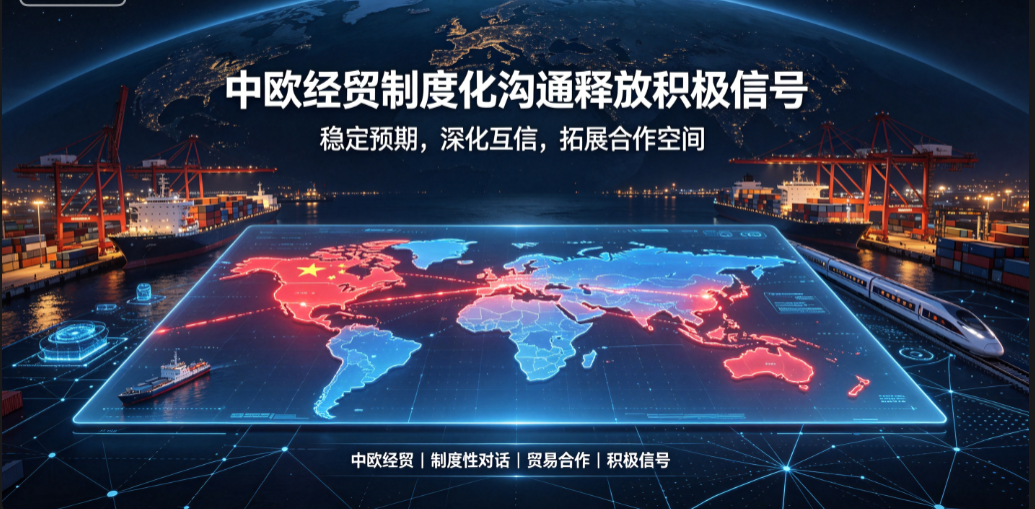
China-EU institutionalized economic talks send positive signals, Trump remarks stir market sentiment
\nKeywords: China-EU trade; institutionalized communication; trade divergences; Trump administration; market disturbance
\nIntroduction
\nAmid profound adjustments in the global economic landscape and challenges to the multilateral trading system, the direction of China-EU economic relations has always drawn market attention. Recently, both sides reaffirmed strengthening institutionalized communication mechanisms during the high-level economic dialogue and agreed to seek feasible solutions through pragmatic approaches to manage trade divergences. This statement not only injects stable expectations into bilateral economic relations but also sends positive signals of openness, cooperation, and joint resilience to the world. Meanwhile, former US President Trump's remarks about "cutting trade with Spain" resurfaced, triggering concerns over the uncertainty of transatlantic trade relations. This article aims to deeply analyze the strategic significance of institutionalized China-EU economic communication and assess the potential impact of Trump's remarks on global market sentiment.
\nI. Institutionalized China-EU Economic Communication: From Dispute Management to Win-Win Cooperation
\nAs two major global economies and important trade partners, bilateral trade between China and the EU has remained at a high level over the years. However, frictions in areas such as technical standards, market access, and green transition have occurred frequently in recent years, necessitating the establishment of more stable and predictable communication mechanisms. This time, both sides agreeing to "seek practical and feasible solutions to manage trade divergences" marks a shift from case-by-case problem solving to systemic institutional building in China-EU economic relations.
\nFirst, institutionalized communication helps reduce the risk of trade friction escalation. In the past, trade disputes between China and the EU relied mostly on ad hoc consultations or WTO dispute settlement mechanisms, which are lengthy and costly. Now, through the establishment of permanent dialogue platforms and joint working groups, both sides can initiate consultations as soon as differences emerge, preventing conflicts from turning into tariff or non-tariff barriers. For example, in the anti-subsidy investigation into electric vehicles, China and the EU have attempted technical dialogue to explain the compliance of China's industrial policies, which is more conducive to maintaining industrial chain stability than resorting to sanctions directly.
\nSecond, institutionalized communication provides a framework for jointly addressing global challenges. In areas such as climate change, digital economy, and supply chain security, the interests of China and the EU are highly aligned. Through institutional channels, both sides can coordinate carbon tariff rules, cross-border data flow standards, and green technology transfer terms, avoiding standard conflicts that raise compliance costs for enterprises while jointly promoting the improvement of global governance rules. The exploration of synergy between the EU's Global Gateway strategy and the Belt and Road Initiative is a fruit of institutionalized communication.
\nFurthermore, the agreement to "seek practical and feasible solutions" reflects a pragmatic problem-solving approach. This implies that China and the EU no longer view divergences as a zero-sum game, but aim to achieve dynamic balance through interest exchange and compensation mechanisms. For instance, on the issue of steel overcapacity, China may offer export quota management in exchange for the EU's more lenient access conditions for Chinese photovoltaic products; in financial openness, the EU could commit to facilitating cross-border RMB settlement in exchange for China further lifting foreign ownership caps in securities, insurance, and other sectors.
\nII. Trump's Remarks Disturb Market: Transatlantic Trade Faces New Tests
\nJust as China-EU economic cooperation emphasizes institutionalization and transparency, Trump's remarks about "cutting trade with Spain" once again exposed the volatility and unpredictability of US trade policy. Although Trump is not currently the US president, as a core figure of the Republican Party, his remarks still trigger concerns about a shift in US foreign policy after the 2024 election.
\nTrump's extreme trade threats are not unprecedented. He previously threatened to withdraw from the WTO, impose high tariffs on China, and levy a "national security tax" on European cars. His targeting of Spain this time may stem from Spain's push for digital services taxes within the EU and its support for North African immigration policies, which run counter to Trump's stance. If Trump returns to power, his pressure on European allies could escalate from "tariff sticks" to a combination of "investment scrutiny + technology blockade + financial sanctions," impacting German cars, French Airbus, Spanish agricultural products, and more.
\nMarket sentiment has already reacted. The euro-dollar exchange rate has recently seen increased volatility, export-oriented stocks in the Euro Stoxx 600 have come under pressure, and Spain's IBEX 35 index once fell over 1.5% in a single day. Investors worry that if a US-EU trade war restarts, the EU might be forced to impose stricter supply chain "de-risking" measures against China, indirectly impacting China-EU trade. In fact, Trump's unilateralism is forcing the EU to make a difficult choice between "strategic autonomy" and the "Atlantic alliance," with the latter often implying higher security costs and trade losses.
\nIII. Divergence and Connection: The Deep Logic of China-US-EU Economic Game
\nInstitutionalized China-EU economic communication and Trump's disruptive remarks, seemingly contradictory, actually reflect three layers of divergence in the current global trading system: first, the divergence between globalization logic and nationalism logic; second, the divergence between multilateralism and unilateralism; and third, the divergence between rule-based competition and power-based competition. China and the EU choosing institutionalized communication is essentially endorsing competitive coexistence within a multilateral framework, while Trump's threatening remarks continue the "America First" path of forcing opponents to compromise through power.
\nIn this context, the window for China-EU cooperation is particularly valuable. On one hand, China can leverage the EU's vigilance toward the US to accelerate rule alignment in digital trade, green finance, and intellectual property protection, weakening the effectiveness of US technology blockades against China. On the other hand, the EU needs the stability of the Chinese market to hedge against US policy uncertainty. In 2023, China-EU trade volume exceeded $800 billion, making China the EU's largest trading partner for consecutive years, and both sides share common ground in responding to discriminatory provisions of the US Inflation Reduction Act (IRA).
\nConclusion
\nThe institutionalization of China-EU economic communication is the result of a rational choice by both sides in the reshaping of the global trade order. It not only provides institutional guarantees for managing frictions but also highlights the mainstream value of openness, cooperation, and mutual benefit. However, the disruption caused by Trump's remarks reminds us that international economic games remain full of uncertainties. China should continue to deepen institutional dialogue with the EU, seek to upgrade green cooperation and digital governance into joint action frameworks, while retaining flexibility in response to US trade policies. Only by finding connections amid divergence and consolidating consensus amidst changes can China-EU economic relations weather the storm and become an important stabilizer for the global economy.