
U.S. Stocks Diverge Sharply: Chip Stocks Enter Technical Bear Market, Chinese Stocks Buck the Trend
\nKeywords: U.S. Stocks, Chip Stocks, TSMC, Chinese Stocks, Gold, Crude Oil, Technical Bear Market
\nI. Introduction
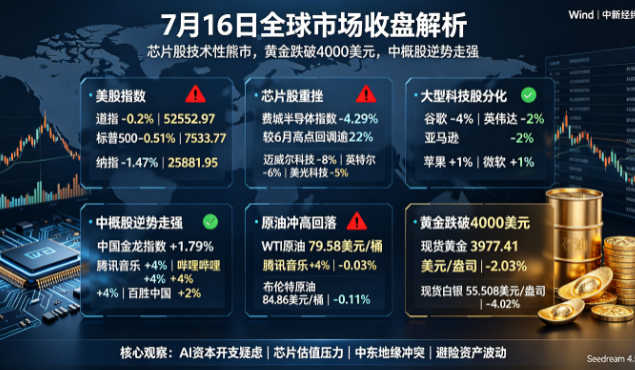
\nAgainst the backdrop of global financial markets closely watching the capital expenditure direction of the artificial intelligence (AI) industry, on July 16 local time, the U.S. stock market showed a significant divergence pattern. The Dow Jones Industrial Average edged down 0.2%, while the tech-heavy Nasdaq Composite fell 1.47%, dragging the S&P 500 down 0.51%. More alarmingly, the Philadelphia Semiconductor Index plunged 4.29%, accumulating a decline of over 22% from its June 22 peak, officially entering a technical bear market. Meanwhile, Chinese stocks rose against the trend, with the Nasdaq China Golden Dragon Index up 1.79%, becoming one of the few bright spots of the day. These signals indicate that the market is returning to rationality from the earlier AI frenzy, and investors are beginning to reassess the high valuations of the semiconductor sector and the sustainability of AI infrastructure investment.
\nII. Market Overview: Tech Stocks Under Pressure, Defensive Sectors Diverge
\nAccording to Wind data, as of the close on July 16 local time, the Dow fell 0.2% to 52,552.97, the S&P 500 fell 0.51% to 7,533.77, and the Nasdaq fell 1.47% to 25,881.95. Large-cap tech stocks showed mixed performance, with the Wind U.S. Tech Seven Giants Index down 1.31%. Among them, Google fell over 4%, Facebook and Nvidia fell over 2%, Amazon fell nearly 2%, and Tesla fell 0.86%; while Apple and Microsoft rose over 1%, reflecting a structural adjustment of capital within the tech sector. SpaceX fell over 3% on Thursday, closing below its IPO price for the first time, further exacerbating concerns about high-growth stocks with high valuations.
\nBank stocks mostly fell: Goldman Sachs fell nearly 5%, Morgan Stanley fell over 4%, Citigroup fell over 2%, JPMorgan Chase fell over 1%, Bank of America fell 0.13%, while Wells Fargo rose 0.64%. Airline stocks were mixed: Boeing fell over 1%, American Airlines fell 0.19%, United Airlines fell over 1%; Delta Air Lines rose nearly 1%, Southwest Airlines rose 0.37%. Energy stocks were mixed: Exxon Mobil rose 1%, Chevron rose over 1%, ConocoPhillips rose over 1%, Schlumberger fell nearly 1%, Occidental Petroleum fell 0.22%. Overall, market risk aversion did not spread widely, but pressure in the tech sector was significant.
\nIII. In-depth Analysis of Chip Stocks: TSMC's 'Sell on the News' Triggers Sector Collapse
\n(A) TSMC's Earnings Beat but Shares Sold Off
\nTSMC's stock fell over 2% on Thursday. The company's second-quarter earnings report released before the market open showed net profit up 77% year-over-year, hitting a record high and surpassing market expectations. However, this stellar result did not boost the chip sector; instead, it acted as a 'sell on the news' catalyst. The market harbors doubts about whether the huge capital expenditures on AI by hyperscalers can continue: despite TSMC's strong earnings, investors worry that as AI hardware valuations become stretched, major cloud computing companies may slow their capex pace. This logic manifests on a macro level: even though TSMC raised its forward guidance, the market responded with selling.
\n(B) Philadelphia Semiconductor Index Enters Technical Bear Market
\nThe Philadelphia Semiconductor Index plunged 4.29% on July 16, accumulating a decline of over 22% from its June 22 peak, officially entering a technical bear market. Individual stocks suffered heavy losses: Marvell Technology fell over 8%, Intel fell nearly 6%, Micron Technology fell over 5%, ARM fell over 5%, AMD fell over 5%, Broadcom fell over 5%, Qualcomm fell over 4%. These companies are all closely related to AI chips, memory, or communication infrastructure, and the breadth of the sell-off reflects market pessimism about the entire semiconductor supply chain.
\n
The chart above shows the decline distribution of the Philadelphia Semiconductor Index and its major constituents on that day, clearly revealing the sector's comprehensive rout.
\n(C) Analyst Divergence: Technical Correction or Trend Reversal?
\nMatt Maley of Miller Tabak emphasized that the movement of chip stocks remains the most critical variable for the stock market, and they are now showing clear cracks. If a strong and sustained rebound fails to materialize, it will send a real warning signal. Bloomberg strategist Tatiana Darie pointed out that the sell-off in chip stocks has approached technical thresholds that have triggered multiple rebounds in recent years, but whether it can stabilize still depends on whether hyperscaler cloud computing companies continue to raise their AI capex expectations. This means the market's future direction is highly dependent on the capital expenditure guidance of tech giants like Microsoft, Amazon, and Google.
\nHowever, Bloomberg's Michael Ball is relatively optimistic, arguing that this sell-off is more 'mechanical' than fundamental. He noted that the main AI capex narrative has not broken down; both TSMC and ASML reported record profits and raised forward guidance, confirming the continued expansion of AI infrastructure construction. For short-term investors, this may present an opportunity to buy after a technical oversold condition; but for medium- to long-term investors, risks of valuation bubbles and overcapacity still need to be monitored.
\nIV. Chinese Stocks Buck the Trend: Capital Inflows and Value Trap Effect
\nAgainst the backdrop of overall pressure in the U.S. stock market, Chinese stocks showed remarkable resilience. The Nasdaq China Golden Dragon Index rose 1.79%, and the Wind China Tech Leaders Index rose 0.83%. Among popular Chinese stocks, Tencent Music rose over 4%, Bilibili rose nearly 4%, Yum China rose over 2%, MINISO rose over 2%, Vipshop rose over 2%, and KE Holdings rose over 2%. This indicates that as global tech valuations become stretched, some funds are flowing to Chinese stocks with more reasonable valuations, seeking a margin of safety.
\nChinese stocks' reversal against the trend was also supported by multiple factors such as improved expectations for domestic economic policy, corporate earnings recovery, and a phased easing of U.S.-China relations. Especially in AI applications, domestic companies like Tencent and Baidu are also accelerating their layout, forming some insulation from overseas chip market trends. Additionally, after significant corrections earlier, some Chinese stocks have seen dividend yields rise, attracting long-term capital.
\nV. European Markets: Mixed Performance, Economic Divergence Emerges
\nEurope's three major stock indexes closed mixed. Germany's DAX fell 0.34% to 24,915.49, France's CAC 40 fell 0.05% to 8,377.86, and the UK's FTSE 100 rose 0.54% to 10,572.24. The divergence in European markets reflects differences in national economic fundamentals: the UK benefited from rising energy stocks and a recovery in services PMI, while Germany and France were weighed down by manufacturing weakness and political uncertainty. The future monetary policy direction of the European Central Bank remains a key variable affecting European stocks.
\nVI. Crude Oil Market: Geopolitical Conflict Fails to Boost Oil Prices, Supply-Demand Game Continues
\nDespite renewed geopolitical conflict in the Middle East, international oil prices rallied but then retreated. As of the close on July 16 local time, WTI crude oil futures settled at $79.58 per barrel, down 0.03%; Brent crude oil futures settled at $84.86 per barrel, down 0.11%. According to Xinhua News, the U.S. Central Command said on social media on July 16 that the U.S. launched a new round of strikes on Iran 'for the sixth consecutive night' to further weaken Iran's military capabilities. The intensity of U.S. strikes has increased recently; on July 15 alone, two rounds of strikes were launched in one day, targeting Iran's command centers, air defense facilities, missile and drone operational capabilities, and coastal surveillance facilities. The U.S. also resumed a naval blockade of Iran on the afternoon of July 14.
\nHowever, the market reacted flatly. Rebecca Babin, senior energy trader at CIBC Private Wealth Group, said that in the absence of substantive escalation, traders are reluctant to push oil prices significantly higher, and the physical market has not yet signaled a serious supply shortage. OPEC+ production policy and expectations of slowing global demand remain the main factors suppressing oil prices. In the short term, oil prices may remain range-bound, with a directional breakout requiring clearer supply disruption or demand surprise signals.
\nVII. Precious Metals: Gold Falls Below $4,000, Safe-Haven Appeal Questioned
\nThe precious metals market suffered a heavy blow. According to Wind data, on July 16 local time, spot gold closed at $3,977.41 per ounce, down 2.03%; spot silver closed at $55.508 per ounce, down 4.02%. In futures, COMEX gold closed at $3,979.9 per ounce, down 1.77%; COMEX silver closed at $55.765 per ounce, down 2.90%. As of press time, spot gold has rebounded slightly, within striking distance of $3,980 per ounce, while silver continued its decline, barely holding the $55 per ounce level.
\nGold's drop below the psychologically important $4,000 per ounce level sparked discussion about its safe-haven appeal. On one hand, the expectation that the Federal Reserve will maintain high interest rates suppresses the appeal of non-yielding gold; on the other hand, geopolitical risks have not significantly boosted gold prices, suggesting that the current market focuses more on real interest rates and the economic outlook than on short-term conflicts. Additionally, the shift of funds from precious metals to higher-yield assets continues. Silver fell more sharply due to its stronger industrial attributes, dragged down by weakness in the semiconductor sector and expectations of slowing economic growth.
\nVIII. Conclusion: Market Enters New Equilibrium, Focus on Earnings Season and Policy Signals
\nOverall, the global financial market on July 16 displayed several core features: First, the valuation bubble in AI hardware stocks began to burst, with the Philadelphia Semiconductor Index entering a technical bear market as the market shifted from 'storytelling' to 'looking at earnings'; second, Chinese stocks became a safe haven for funds, with valuation advantages and policy expectations attracting buying; third, the impact of geopolitical conflict on commodity markets was limited, with supply-demand fundamentals still dominant; fourth, precious metals' pullback highlights interest rate environment pressure, and market risk appetite has not yet systematically deteriorated.
\nGoing forward, investors need to focus on several key points: first, the capital expenditure guidance of hyperscale cloud computing companies (such as Microsoft, Amazon, Google) and whether they can continue to raise expectations will determine whether chip stocks can stabilize; second, the signals from the Federal Reserve's July meeting, as any advance or delay in the timing of rate cuts will affect tech valuations; third, the potential impact of diplomatic events such as a U.S.-China summit on Chinese stocks and global trade. In the short term, the market may remain highly volatile, but the structurally driven growth path led by AI has not been disproven, and technical corrections may also create new positioning opportunities. For equity investors, this phase calls for more selective stock picking, avoiding overly high-priced concept stocks and focusing on leading companies with strong earnings certainty.
\n(This article is based on public market data and analysis views and does not constitute investment advice.)

