
US Stock Market Divergence Intensifies: Nasdaq Five-Day Losing Streak, Apple Market Cap Breaks $5 Trillion
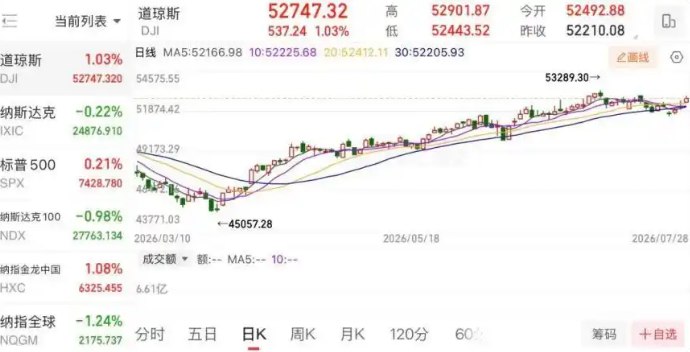
On July 28 local time, the three major US stock indexes continued their divergent pattern, with the S&P 500 and Dow Jones Industrial Average edging up while the Nasdaq Composite fell for a fifth consecutive trading day, reflecting multiple concerns over tech stock valuations, interest rate policy outlook, and geopolitical risks. At the close, the Dow rose 537.24 points, or 1.03%, to 52,747.32; the S&P 500 gained 15.6 points, or 0.21%, to 7,428.78; and the Nasdaq dropped 55.17 points, or 0.22%, to 24,876.91. Internal market structure was clearly polarized, with cyclical and growth stocks moving in opposite directions, and investor sentiment oscillating between optimism and caution.
Tech Stock Internal Divergence, Apple Market Cap Hits Record High
Large-cap tech stocks were mixed with varied performances. Google parent Alphabet rose over 2%, Microsoft gained over 1%, Apple added nearly 1%, and Nvidia edged up 0.25%. On the other hand, Tesla fell 0.58%, Amazon dropped 0.23%, and Facebook (Meta) slipped 0.08%. Apple hit an intraday high of $342.89 per share, briefly surpassing a $5 trillion market cap, becoming the second global company to reach this milestone after Nvidia. Apple's strong performance was mainly driven by its steady services revenue growth and optimistic expectations for its upcoming new product lines. However, the overall weakness in the Nasdaq indicates that upward momentum in the tech sector is fading, and investors are beginning to reassess the sustainability of high-valuation stocks.
Cyclical Stocks Mixed, Energy and Shipping Sectors Under Pressure
Bank stocks mostly fell, with JPMorgan edging up 0.33%, while Goldman Sachs and Morgan Stanley each fell over 1%, Citigroup dropped 0.44%, Bank of America rose 0.79%, and Wells Fargo fell 0.39%. Energy stocks declined across the board, impacted by a sharp drop in international oil prices, with Exxon Mobil, Chevron, and ConocoPhillips all falling over 1%, Schlumberger dropping over 3%, and Occidental Petroleum falling over 1%. Airline stocks collectively rose, with Boeing up over 4%, and American Airlines, Delta Air Lines, Southwest Airlines, and United Airlines all gaining more than 2%. The contrarian rise in airline stocks may reflect optimistic expectations for summer travel demand and the benefit of lower oil prices reducing operating costs.
Chip and Storage Stocks Suffer Heavy Losses
Chip stocks were weak, with the Philadelphia Semiconductor Index plunging 4.49%. Micron Technology fell nearly 9%, Advanced Micro Devices (AMD) dropped over 8%, ARM fell over 8%, Applied Materials slid over 7%, Marvell Technology lost over 7%, and Intel fell over 5%. Storage stocks suffered even steeper declines, with SanDisk falling over 14%, SK Hynix nearly 9%, Seagate Technology over 8%, and Western Digital over 6%. The downward pressure on the storage industry primarily stems from weak global demand and oversupply concerns, coupled with geopolitical tensions posing potential risks to the semiconductor supply chain. Market doubts have arisen over whether demand for AI chips can sustain overall semiconductor sector growth.
Most Chinese ADRs Strengthen
Chinese ADRs overall outperformed the broader market, with the Nasdaq Golden Dragon China Index rising 1.08%. Autohome gained over 7%, Lufax rose over 6%, Li Auto added over 4%, Atour climbed over 4%, Hesai Technology gained over 3%, NetEase rose nearly 3%, and JD.com added over 2%. On the other hand, ACM Research fell nearly 10%, 21Vianet dropped over 5%, and GDS Holdings fell over 2%. The rise in Chinese ADRs was partly fueled by expectations of China's economic stimulus policies and better-than-expected earnings from some companies.
Macro Data and Policy Expectations Intertwined
On the news front, a preliminary survey by the Conference Board, a US research organization, showed that the US consumer confidence index for July stood at 90.8, down from 92.2 in June. Consumers' inflation expectations for the next 12 months eased, but the proportion of consumers expecting higher interest rates in the coming year remained at 61.3%. This data indicates that while inflation pressures have eased, the high interest rate environment continues to weigh on consumer confidence.
The Federal Reserve will release its July policy decision on Wednesday local time. According to the CME Group's FedWatch Tool, traders assign a 71% probability of the Fed holding rates steady and a 29% probability of a 25-basis-point hike. The market widely expects the Fed to adopt a wait-and-see stance, but if inflation data rebounds, the option of a rate hike is not off the table.
Geopolitical Risks Heat Up
On July 28 local time, the US Central Command stated that Iran's Islamic Revolutionary Guard Corps launched several ballistic missiles from Iranian territory in an attempted surprise attack on US forces in the Middle East. All missiles were successfully intercepted, and US forces remained on high alert and combat-ready. This incident escalated tensions in the Middle East, impacting crude oil supply expectations and partly explaining the significant decline in international oil prices that day.
International Oil Prices Plunge, Dollar and Precious Metals Weaken
Driven by geopolitical events and global demand concerns, international oil prices plummeted. At the close, light sweet crude for September delivery on the New York Mercantile Exchange fell $3.35 to $79.26 per barrel, a decline of 4.06%; London Brent crude futures fell $4.27 to $84.09 per barrel, down 4.83%. The plunge in oil prices further dragged down the energy sector and dampened overall market sentiment.
The US dollar index fell 0.12% to close at 101.417. In precious metals, COMEX gold futures dropped 1.18% to $4,028.80 per ounce, and COMEX silver futures fell 2.35% to $57.34 per ounce. The decline in gold and silver prices contrasted with the weakening dollar, possibly reflecting market concerns about liquidity tightening and shifts in risk appetite.
European Stocks Rise Across the Board
Europe's three major stock indexes all rose on the 28th, contrasting with the divergent US market. The UK's FTSE 100 gained 0.83%, France's CAC 40 rose 0.63%, and Germany's DAX added 0.41%. European markets may have benefited from relatively stable economic data and expectations of improved corporate earnings.
Summary and Outlook
The US stock market is currently at a critical juncture of a tug-of-war between bulls and bears. On one hand, the strong performance of tech giants (such as Apple's market cap breaking $5 trillion) provides support; on the other hand, the weakness in the chip sector, declining consumer confidence, Fed policy uncertainty, and escalating geopolitical risks are making market sentiment cautious. The Nasdaq's five-day losing streak reflects valuation correction pressure on growth stocks, while the Dow's rise highlights the relative advantages of defensive sectors and cyclical stocks. In the coming weeks, investors should closely monitor the outcome of the Fed's policy meeting, inflation data, and developments in the Middle East, as these factors will determine whether the US market can reverse its divergence and move toward a more balanced uptrend.

