
US stock divergence intensifies: chip sell-off continues, traditional sectors undergo valuation revaluation
On July 28 local time, the US stock market showed a significant divergence pattern. The Dow Jones Industrial Average rose 1.03% to close at 52747.32 points, while the Nasdaq Composite fell 0.22% to 24876.91 points, and the S&P 500 edged up 0.21% to 7428.78 points. Behind this trend lies the fierce battle between investors' concerns over the ongoing sell-off in the tech sector, especially chips, and their renewed favor for traditional industries.
Chip stock sell-off persists, sector undergoes deep correction
The Philadelphia Semiconductor Index slumped 4.49% on the day, extending the previous session's decline. The memory sector was hardest hit: Micron Technology closed down 8.85%, SK Hynix fell 8.98%, and SanDisk plunged 14.25%, with its stock price halved since July. The optical communication sector also performed poorly, with Corning falling over 12% and Coherent dropping more than 10%. In addition, Dell Technologies, Intel, and AMD fell 8.15%, 5.86%, and 8.15% respectively.
JPMorgan TMT industry expert Josh Meyers attributed the semiconductor weakness to three factors: weak earnings reactions, persistent concerns over cycle financing, and anxiety over possible capital expenditure cuts by cloud service providers. He pointed out that positions remain high and a true broad clearing in the tech sector has yet to come.
Notably, SK Hynix plunged in US after-hours trading, falling over 8% at one point. The latest earnings report showed that the company's Q2 2026 revenue and operating profit both missed market expectations, further fueling investor concerns about the chip industry's fundamentals.
Tech giants diverge, Apple hits record high
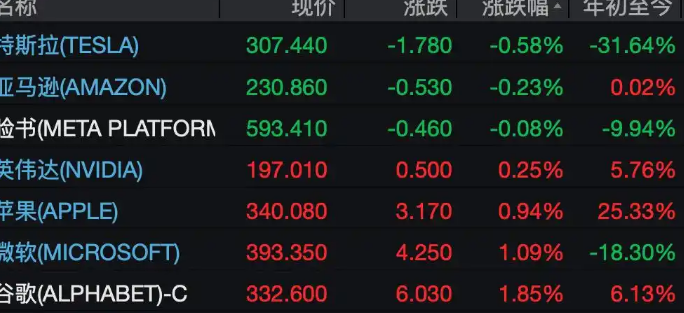
In stark contrast to the weakness in chip stocks, some large-cap tech stocks still showed resilience. The Wind US Tech Seven Giants Index rose 0.69%. Google gained over 2.19%, Microsoft rose more than 1%, Apple climbed 0.94%, once hitting a record high of $342.89 during the session, with its market cap breaking $5 trillion for the first time, before closing at $340.08, with a market cap of about $4.99 trillion. Meanwhile, Tesla, Amazon, and Meta fell 0.58%, 0.23%, and 0.08%, respectively.
This divergence reflects investors conducting more cautious assessments of AI-related concept stocks. Ross Mayfield, investment strategist at Baird, noted: "This is a true broad sector rotation. The story of this momentum clearing has been ongoing for 6 to 8 weeks, and it has much more to do with market technicals than any fundamental change."
Chinese stocks shine, software sector strengthens
Compared to the gloom in chip stocks, Chinese stocks performed better on the day. The Nasdaq China Golden Dragon Index closed up 1.08%. Alibaba rose 0.17%, Pinduoduo rose 1.01%, NetEase rose 2.89%, JD.com rose 2.71%, Li Auto rose 4.68%, and Trip.com rose 1.21%. NIO, the new energy vehicle maker, also rose 1.3%.
The software sector became a market highlight of the day. Adobe closed up 4.81%, IBM up 5.21%, Salesforce up 4.55%, FactSet up 6.76%, and Thomson Reuters up 5.66%. This indicates that funds are shifting from high-valuation chip and AI-related stocks to traditional software and services areas.
Geopolitical easing combined with commodity market adjustment
On the news front, US President Trump met with Israeli Prime Minister Netanyahu, with the White House calling the talks "positive and constructive." This signal of geopolitical easing drove a shift in market risk appetite.
Affected by the mutual cessation of strikes between the US and Iran, concerns over Middle East geopolitical tensions eased, causing international oil prices to drop sharply. WTI September crude oil futures fell 4.06% to close at $79.26 per barrel, the first close below $80 since July 16; Brent September crude oil futures fell 4.83% to $84.09 per barrel. Precious metals also came under pressure, with London spot gold down 1.21% at $4028.3 per ounce, and COMEX gold futures down 1.18% at $4028.80 per ounce.
Deep logic behind sector rotation
Goldman Sachs trader Ariana Contessa commented: "Market pain continues, with earnings 'buy the rumor, sell the fact', factor volatility, and calendar effects combining to create a buyer's strike atmosphere. Investors are looking for signs that the market is stabilizing after weeks of violent swings."
Currently, the Federal Reserve is set to release its latest rate decision on Wednesday, with Microsoft and Meta reporting earnings after the close on Wednesday, and Apple and Amazon disclosing data on Thursday. These key events will determine whether the market can find a new direction.
Overall, the current divergence in US stocks is not a short-term phenomenon but reflects a longer-term valuation restructuring process. Investors are reassessing the gap between growth expectations and actual performance of popular sectors like AI and chips, while seeking investment targets with more reasonable valuations and stronger fundamentals. This dynamic adjustment may continue in the coming weeks until the market finds a new equilibrium.

